Brixton Metals Makes Copper-Gold-Silver Porphyry Discovery at the Tempest Target on its Thorn Project
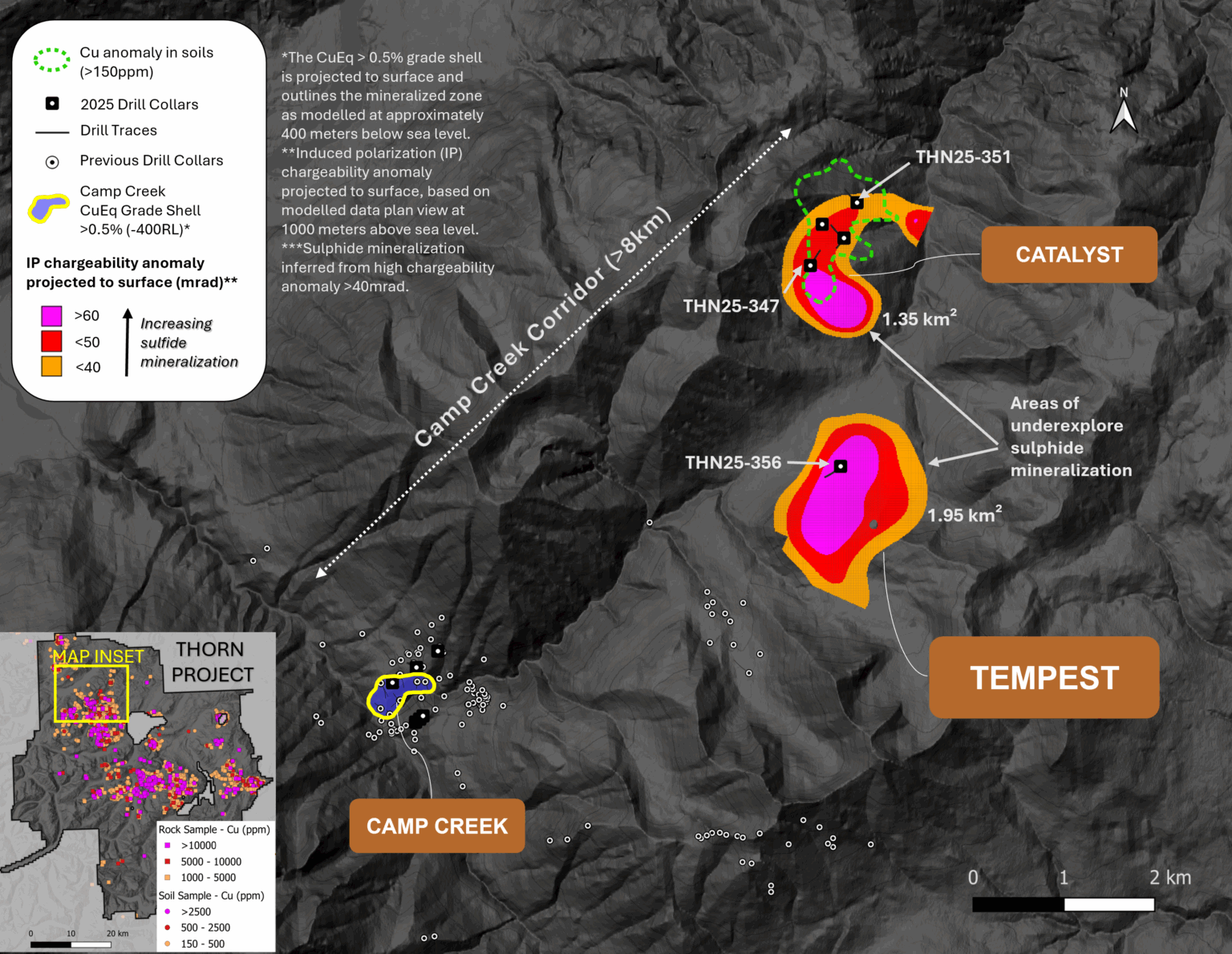
VANCOUVER, British Columbia, December 1, 2025 Brixton Metals Corporation (TSX-V: BBB, OTCQB: BBBXF) (the “Company” or “Brixton”) is pleased to announce the discovery of a second copper-gold porphyry system this season at the Tempest Target within its wholly owned Thorn Project located in northwestern British Columbia. The Tempest Porphyry Target is located approximately 2 kilometres southwest of the recently discovered Catalyst porphyry system (see news release, October 30, 2025) along a northeast-southwest trending corridor that hosts multiple underexplored porphyry-style prospects, including the Camp Creek Porphyry (Figure 1). One single hole was drilled at Tempest during the 2025 season. Assays from this hole confirm the presence of copper, gold, silver and molybdenum mineralization associated with porphyritic rocks exhibiting moderate to intense alteration and veining. This release also includes the remaining results from two holes at the Catalyst target.
Highlights
- First-Ever Drilling at Tempest Returns Copper-Gold-Silver Mineralization, confirming the presence of a hydrothermal system with porphyry-style alteration and mineralization
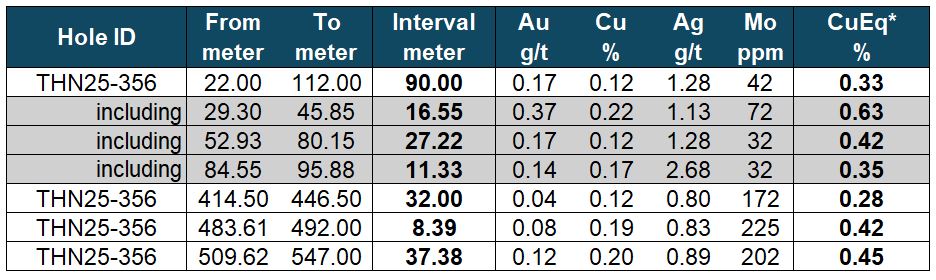
- Hole THN25-356 returned 90.00meters of 0.33% CuEq from22.00 meters
- Including 16.55 meters of 0.63% CuEq from 29.30 meters
- Including 27.22 meters of 0.42% CuEq from 52.93 meters
Chairman, CEO, Gary R. Thompson stated, “Intersecting two mineralized porphyry systems with our first-ever drill holes at both Catalyst and Tempest is a remarkable achievement and not something commonly seen in the industry. A big congratulations goes out to the Brixton team. These results underscore the exceptional prospectivity of the Camp Creek Corridor and reinforce our belief that the Thorn Project has the potential to host a large, multi-center mineralized system. The continuity of copper, gold, and silver mineralization, combined with strong geophysical signatures and classic porphyry-style alteration, highlights the importance of this underexplored district. We are excited to continue advancing exploration and further define the scale and grade of these promising new targets.”
Figure 1. Plan Map of the 2025 Drill Collars within the Camp Creek Corridor.
Table 1. Select Assay Intervals for hole THN25-356 from the Tempest Target.
Table 2. Select Assay Intervals for holes THN25-347 and THN25-351 from the Catalyst Target.
Reported assay intervals are weighted averages as drilled lengths as true widths have not yet been determined. *Copper equivalent (CuEq) calculation: CuEq is calculated based on metal prices as an approximate average of the last twelve months ending September 2025, specifically: Copper US$ 4.70 lb., Gold US$ 3100 oz, Silver US$ 35 oz, and Molybdenum US$ 30 lb. Due to the early-stage nature of the target, and the absence of metallurgical test work, a conceptual recovery of 85% is assumed for all metals in this calculation. These assumed recoveries have no basis in actual metallurgical testing, and actual recoveries may be materially different. The general formula used for CuEq calculation is: CuEq% = Cu % + ((Au g/t * (Au recovery/Cu recovery) * ((Au $ per oz./31.1034768)/(Cu $ per lb. * 22.04623))) + ((Ag g/t * (Ag recovery/Cu recovery) * ((Ag $ per oz./31.1034768)/(Cu $ per lb. * 22.04623))) + ((Mo % * (Mo recovery/Cu recovery) * (Mo $ per lb. /Cu $ per lb.))
Discussion About the Tempest Copper-Gold System
The Tempest porphyry area features a relatively flat landscape, predominantly covered by landslide and glacial deposits. Despite this cover, several mineralized porphyry outcrops were identified late in the 2024 field season. In 2025, these outcrops underwent detailed mapping, complemented by a TITAN DCIP (Direct Current and Induced Polarization) geophysical survey and geochemical soil sampling. Insights from these activities guided the placement of the first-ever exploratory drill hole in the area (THN25-356).
The mapped outcrops are mainly composed of fine-grained felsic volcanoclastic rock lenses, which are in contact with locally mineralized and altered fine-grained feldspar-rich porphyries. Most of the scree covering the area consists of medium to coarse-grained biotite-hornblende diorite, interpreted as part of the Thorn Stock, with extensive meter-wide diorite outcrops present at higher elevations. This scree is believed to have been transported downslope from these outcrops, muting the geochemical response and obscuring potential soil and rock anomalies. Nevertheless, through meticulous mapping, Brixton geologists identified key structural trends that informed the drilling strategy.
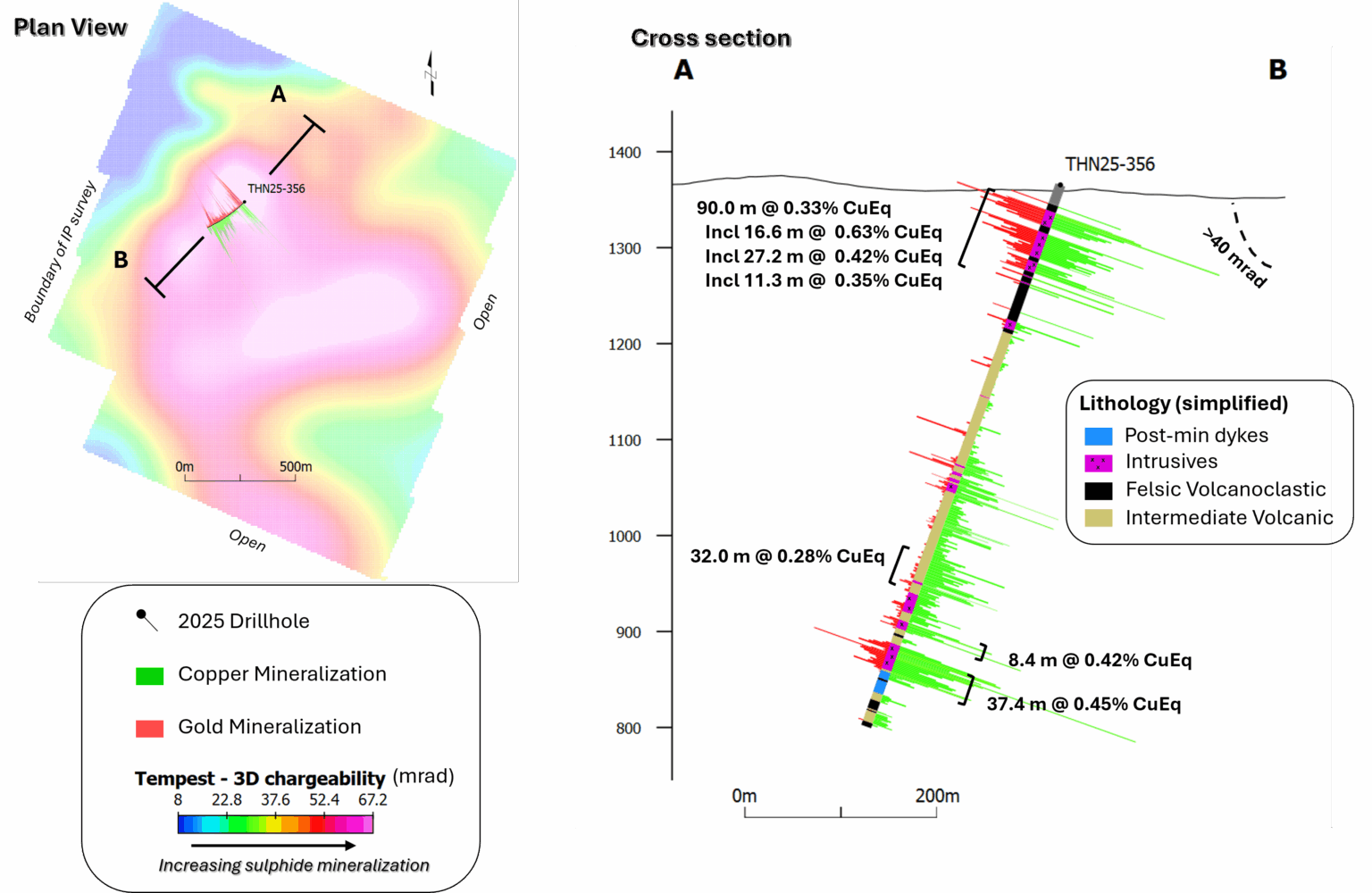
In 2025, a single drill hole was completed to test the mineralization concept at Tempest. The results confirmed the presence of mineralized porphyries containing copper, gold, silver, and molybdenum mineralization. At least two mineralized porphyries were identified, one fine-grained feldspar-rich porphyry at surface and one medium-grained dioritic porphyry at depth. These porphyries intrude fine-grained felsic volcaniclastic and intermediate volcaniclastic packages, as evidenced by cross-cutting relationships. Notably, Cu-Au-Ag-Mo mineralization occurs in well-defined intervals, especially in shallower sections (Figure 2). This pattern is interpreted as a result of wall-rock reactivity: mineralization and alteration are less pronounced in non-reactive felsic volcanoclastic rocks, while intermediate rocks display moderate mineralization and alteration when in contact with mineralized porphyries. Alteration within the porphyritic rocks is characterized by a phyllic assemblage consisting of sericite, pyrite, and quartz, which locally overprints earlier potassic alteration.
These results from the initial hole, which revealed two mineralized porphyries with distinctive textural differences and geochemical signatures, suggest the potential for a multiphase porphyry system. Additionally, the extensive high chargeability anomaly identified in the Tempest area points to the potential for a large, sulphur-rich hydrothermal system (plan view in Figure 2).
Figure 2. Map illustrating the extensive chargeability (IP) anomaly at Tempest, alongside a cross-section of drill hole THN25-356 that highlights the simplified geology and zones of copper and gold mineralization.
Figure 3. HQ drill core close-up photographs of main lithologies and styles of alteration-mineralization at the Tempest Porphyry Target, hole THN25-356.
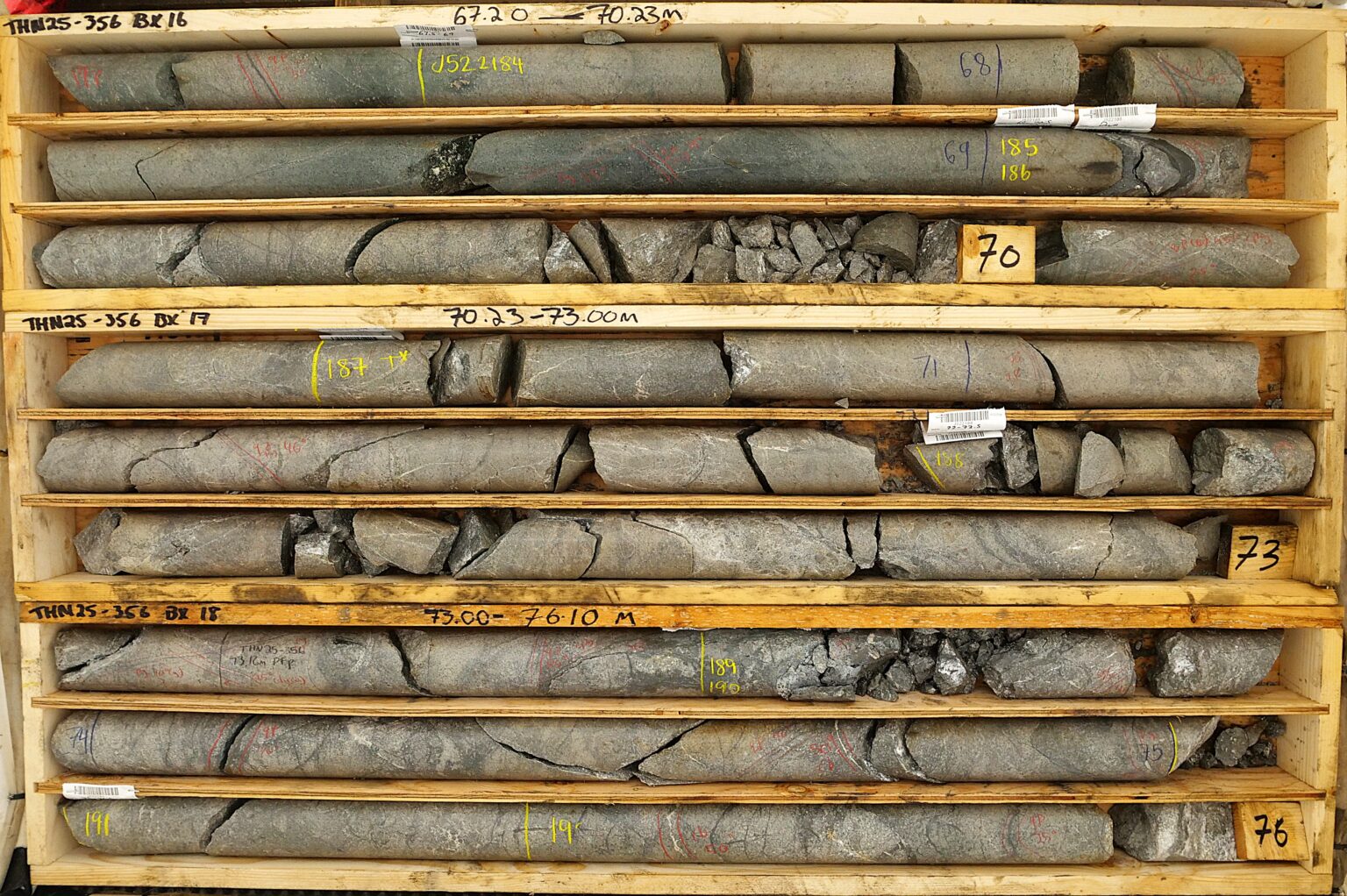
Figure 4. HQ drill core photographs of hole THN25-356 from 67.20 to 76.10 meters.
Exploration Strategy
Brixton has adopted a scale-focused drilling strategy, with large step-outs of drill collars between drilling pads. This approach is designed to rapidly assess the lateral continuity and size potential of the mineralized systems. To date, five drill holes have been completed at the Catalyst Target for a combined total of 2670m, all of which intersected porphyry-style alteration and mineralization. One drillhole was drilled to a depth of 601m at the Tempest Porphyry Target, located approximately 2 kilometres southwest of Catalyst (Figure 1). Drilling at Tempest has also intersected porphyry-style alteration and mineralization, reinforcing the corridor’s potential to host a large-scale, multi-center porphyry system. While a direct connection between the Catalyst and Tempest systems has not yet been established, investigating this relationship will be a priority for future exploration campaigns, as it represents great exploration potential for near-surface mineralization in a 2 km section.
About the Catalyst Porphyry Target
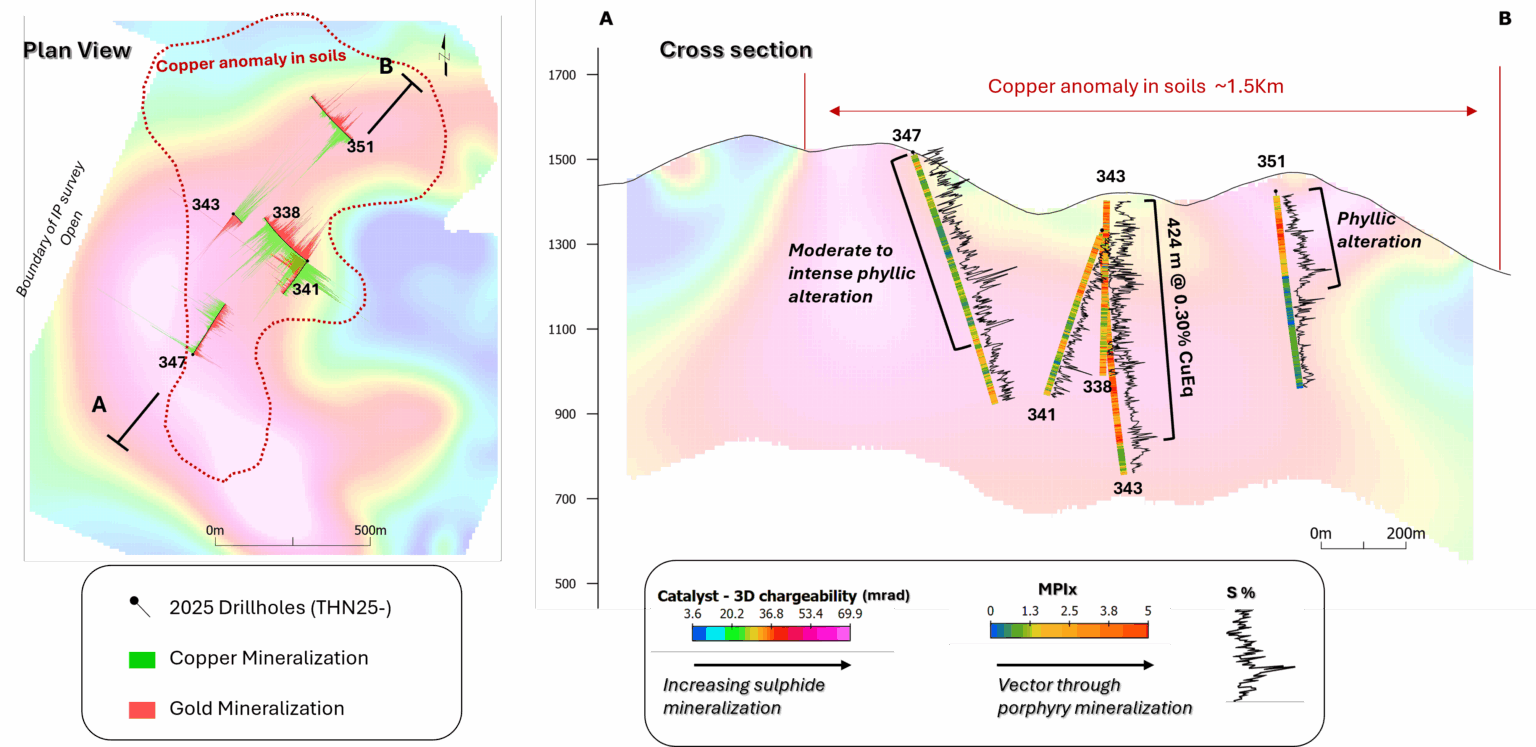
In a news release issued in October 2025, Brixton announced the discovery of the Catalyst porphyry system, marking the first drilling ever conducted in the area. Three holes reported presented various intervals of Cu-Au-Ag-Mo mineralization associated with at least two intrusive phases (see news release, October 30, 2025). Results from the last two holes drilled at Catalyst during the 2025 season show extensive and moderate hydrothermal alteration characterized by disseminated sulphides, quartz, sericite and chlorite. This, combined with SWIR (short-wave infrared spectroscopy) analysis, shows a characteristic phyllic alteration assembly in these two holes. Furthermore, through the application of the MDRU Porphyry Index (MPIx), a ratio of proximal and distal elements in a copper porphyry system (see MDRU MPIx) shows zones outside the known mineralized area with high MPIx values, suggesting the proximity to mineralized areas. The extensive hydrothermal alteration footprint, combined with encouraging geochemical indicators, suggests the presence of a large hydrothermal system (Figure 5).
Figure 5. Plan view and cross-section looking northwest at the Catalyst porphyry system.
Table 3. Collar Location for Reported Drillholes.
Quality Assurance & Quality Control
Quality assurance and quality control protocols for drill core sampling were developed by Brixton. Core samples were mostly taken at 1.5m intervals. High-grade intervals were taken at 0.5m. Blank, duplicate (lab pulp) and certified reference materials were inserted at a combined rate of up to 15%. Core samples were cut in half, bagged, zip-tied, and sent directly to the ALS Minerals preparation facility in Whitehorse, Yukon, or Langley, British Columbia, depending on available lab capacity. ALS Minerals Laboratories is registered to ISO 9001:2008 and ISO 17025 accreditations for laboratory procedures. Samples were analyzed at ALS Laboratory Facilities in North Vancouver, British Columbia for gold by fire assay with an atomic absorption finish, whereas Ag, Pb, Cu and Zn and 48 additional elements were analyzed using four acid digestion with an ICP-MS finish. Overlimits for gold were analyzed using fire assay and gravimetric finish. The standards, certified reference materials, were acquired from CDN Resource Laboratories Ltd. of Langley, British Columbia, and the standards inserted varied depending on the type and abundance of mineralization visually observed in the primary sample. Blank material used consisted of non-mineralized siliceous landscaping rock. A copy of the QAQC protocols can be viewed at the Company’s website.
Qualified Person (QP)
Ms. Madeline Berry, P.Geo., is a Project Geologist for the Company who is a Qualified Person as defined by National Instrument 43-101. Ms. Berry has verified the referenced data and analytical results disclosed in this press release and has approved the technical information presented herein.
About Brixton Metals Corporation
Brixton Metals is a Canadian exploration company focused on the advancement of its mining projects. Brixton wholly owns four exploration projects: Brixton’s flagship Thorn copper-gold-silver-molybdenum Project, the Hog Heaven copper-silver-gold Project in NW Montana, USA, which is optioned to Ivanhoe Electric Inc., the Langis-HudBay silver-cobalt-nickel Project in Ontario and the Atlin Goldfields Project located in northwest BC, which is optioned to Eldorado Gold Corporation. Brixton Metals Corporation shares trade on the TSX-V under the ticker symbol BBB, and on the OTCQB under the ticker symbol BBBXF. For more information about Brixton, please visit our website at www.brixtonmetals.com.
On Behalf of the Board of Directors
Mr. Gary R. Thompson, Chairman and CEO
info@brixtonmetals.com
For Investor Relations inquiries please contact: Mr. Michael Rapsch, Vice President Investor Relations. email: michael.rapsch@brixtonmetals.com or call Tel: 604-630-9707
NT4


This article comes from NationTalk:
https://bc.nationtalk.ca
The permalink for this story is:
https://bc.nationtalk.ca/story/brixton-metals-makes-copper-gold-silver-porphyry-discovery-at-the-tempest-target-on-its-thorn-project
Comments are closed.